
What If Earth Suddenly Stopped Spinning?
What if Earth suddenly stopped spinning? Discover how inertia could trigger devastating winds, ocean surges, and catastrophic changes to life on our planet.
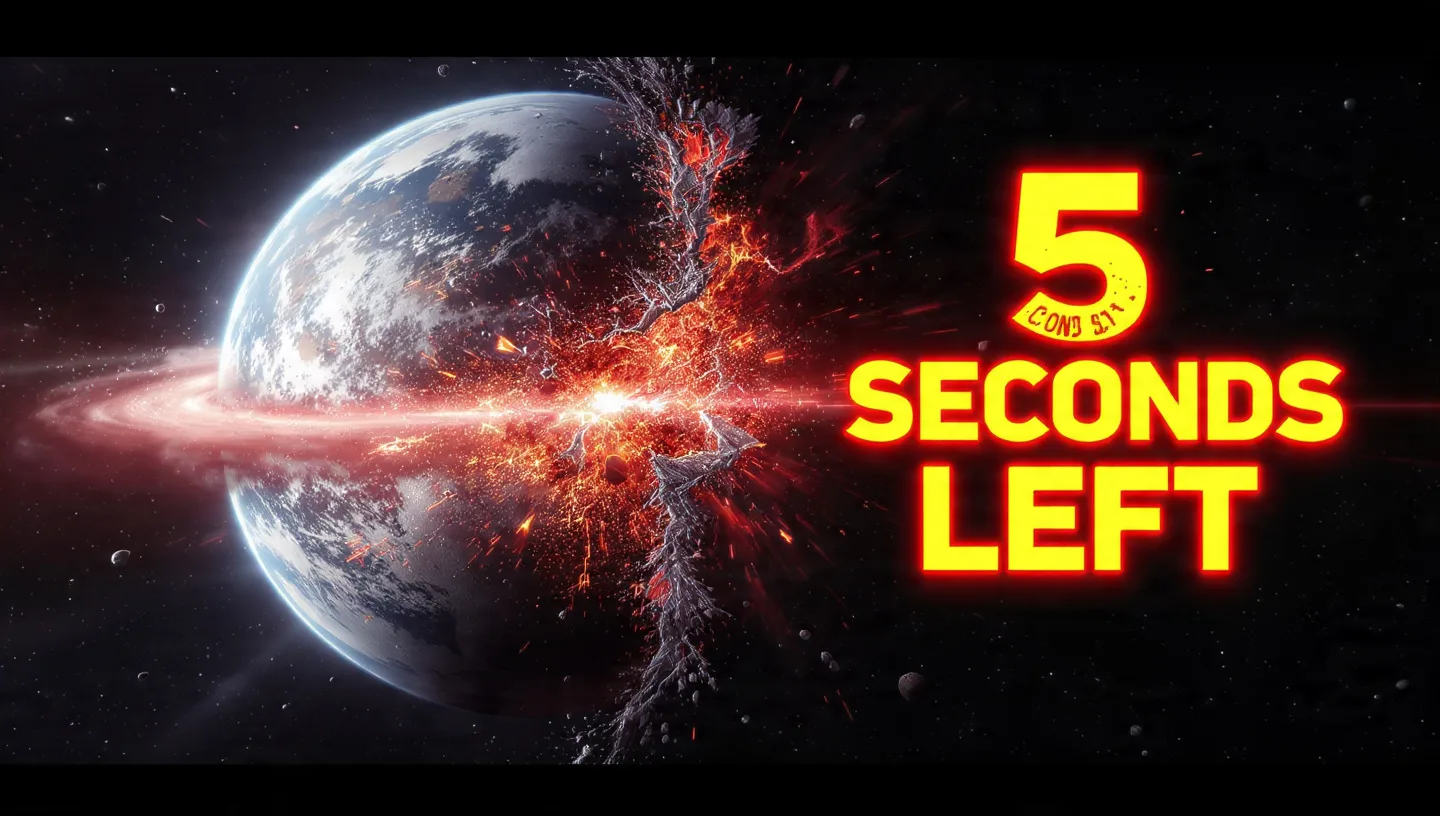
What If Earth Suddenly Stopped Spinning?
Earth may feel perfectly still beneath our feet, but our planet is constantly rotating. At the equator, its surface moves at roughly 1,670 kilometres per hour because of this rotation. We do not notice the motion because the ground, atmosphere, and everything around us generally move together.
But what if Earth suddenly stopped spinning? If the planet's rotation came to an almost instantaneous halt, the consequences could be catastrophic. Inertia would keep the atmosphere, oceans, and objects near the surface moving initially, creating a chain of extreme physical effects. Let's explore what physics tells us about this hypothetical scenario.
What Would Happen in the First Few Seconds?
The most immediate danger would come from inertia. An object in motion tends to remain in motion unless an external force changes its movement. Because people, buildings, vehicles, and the landscape currently share Earth's rotation, an abrupt stop of the ground would leave many objects moving relative to the surface.
At the equator, the rotational speed is about 1,670 kilometres per hour. The speed is lower at higher latitudes and approaches zero at the geographic poles. These figures describe the eastward speed caused by Earth's rotation, not the speed at which everyone would necessarily travel after a hypothetical stop.
In this scenario, people and unsecured objects could be thrown eastward relative to the ground. The atmosphere and oceans would also retain much of their initial motion. The actual destruction would depend on how the planet stopped, how quickly forces acted, and how Earth's surface and atmosphere responded.
Could Earth Develop Extremely Powerful Winds?
Yes, an abrupt stop could produce devastating atmospheric motion. Earth's atmosphere rotates along with the planet on average, but air has inertia too. If the ground stopped rotating almost instantly, the air would not automatically stop at the same moment.
This difference in motion could create extraordinarily destructive winds, especially in the initial stages. Buildings, forests, infrastructure, and ecosystems could suffer severe damage. The exact wind speeds and global pattern cannot be predicted with confidence from this simplified thought experiment.
Earth's real atmosphere is complex. Pressure differences, friction, terrain, and interactions between air and the surface would all influence what happened. Therefore, it is more accurate to describe extreme winds as a likely consequence of the hypothetical sudden stop than to assign a precise wind speed.
What Would Happen to the Oceans?
The oceans would not instantly become still if Earth's solid surface stopped rotating. Water would retain its motion, potentially driving enormous surges, severe coastal flooding, and widespread disruption. Coastlines and low-lying regions could be especially vulnerable.
These effects would not necessarily resemble a single, uniform wave travelling around the world. Ocean depth, the shape of coastlines, seafloor topography, and the way the stop occurred would influence how water moved. The scenario is too extreme and underspecified to predict a reliable worldwide wave height.
Even without assigning exact measurements, the basic physics is clear: water already in motion does not simply stop because the surface beneath it suddenly stops. The resulting movement could be devastating.
Would Earthquakes and Volcanoes Occur?
It is tempting to assume that a sudden stop would automatically trigger every kind of natural disaster. However, earthquakes and volcanic eruptions depend on specific geological processes, such as stress changes in Earth's crust, movement along faults, and the behaviour of magma.
A hypothetical abrupt change to Earth's rotation could involve enormous forces, but we cannot confidently predict that it would trigger worldwide earthquakes or widespread volcanic eruptions without specifying a physically consistent mechanism for stopping the planet. These outcomes should not be presented as guaranteed consequences.
Could Life Survive if Earth Stopped Spinning?
If Earth's rotation stopped almost instantaneously, the initial physical disruption would threaten humans, animals, plants, and many ecosystems. Extreme winds, moving water, and damage to habitats and infrastructure could make survival difficult across many regions.
Some organisms might survive in protected environments, but survival would depend on local conditions and the details of the event. It would be misleading to claim that every living thing would die instantly, just as it would be misleading to suggest that human civilisation could easily withstand the disaster.
The longer-term consequences would also depend on whether Earth continued orbiting the Sun and whether its axial tilt remained unchanged.
Would Day and Night Still Happen?
If Earth stopped rotating relative to the distant stars but continued revolving around the Sun, the familiar 24-hour day-night cycle would disappear. The Sun would still appear to move across the sky slowly because Earth would continue along its orbit.
In a simplified scenario with Earth's axis and orbit otherwise unchanged, many locations would experience daylight and darkness lasting for roughly half a year each, rather than changing every 24 hours. Actual conditions would depend on latitude, the planet's axial tilt, and how the hypothetical change affected Earth's orientation.
Such prolonged periods of sunlight and darkness could produce major temperature changes, disrupting weather patterns, agriculture, water availability, and ecosystems. Earth's rotation is therefore important not only for the apparent daily movement of the Sun but also for the conditions under which life has developed.
Could Earth Really Stop Spinning Suddenly?
There is no known realistic natural process that could bring Earth's rotation to a sudden halt. Earth's spin is governed by angular momentum, and stopping a planet this massive would require an extraordinary transfer of angular momentum and energy.
Earth's rotation does change very slightly over time due to effects including tidal interactions with the Moon and exchanges of angular momentum within the Earth system. These gradual changes are entirely different from the imaginary instant stop explored in this article.
Final Thoughts: Why Earth's Rotation Matters
What if Earth suddenly stopped spinning? The most immediate consequences of an almost instantaneous stop would likely involve inertia: the ground would stop rotating while the atmosphere, oceans, and objects near the surface initially retained their motion. The resulting winds, water movement, and disruption could be catastrophic.
The details of this scenario remain hypothetical, and some outcomes cannot be predicted precisely without a physically consistent model. Still, the thought experiment highlights an important lesson from physics: motion does not disappear simply because the surface beneath an object changes its movement.
Earth's rotation is an ordinary part of life, but it plays a fundamental role in shaping our days, atmosphere, oceans, and environment.
Sources & Further Reading
- Earth Rotation — NASA Technical Reports Server (NASA) Research Institution
- The Coriolis Effect — NOAA National Environmental Satellite, Data, and Information Service (NESDIS) Government Agency
- What Is the Coriolis Effect? — NOAA National Environmental Satellite, Data, and Information Service (NESDIS) Reputable Reference (Aug 26, 2025)
Frequently Asked Questions
UltraFactX Editorial Team
Official editorial and research team at UltraFactX Studio.
Related Discoveries
Explore More from UltraFactX Studio
Dive deeper into the universe, nature, physics, human psychology, and the mysteries of ancient civilization.