
What If the Sun Disappeared? What Would Happen to Earth?
What if the Sun suddenly disappeared? Discover how Earth would lose sunlight, cool down, disrupt ecosystems, and drift through space.
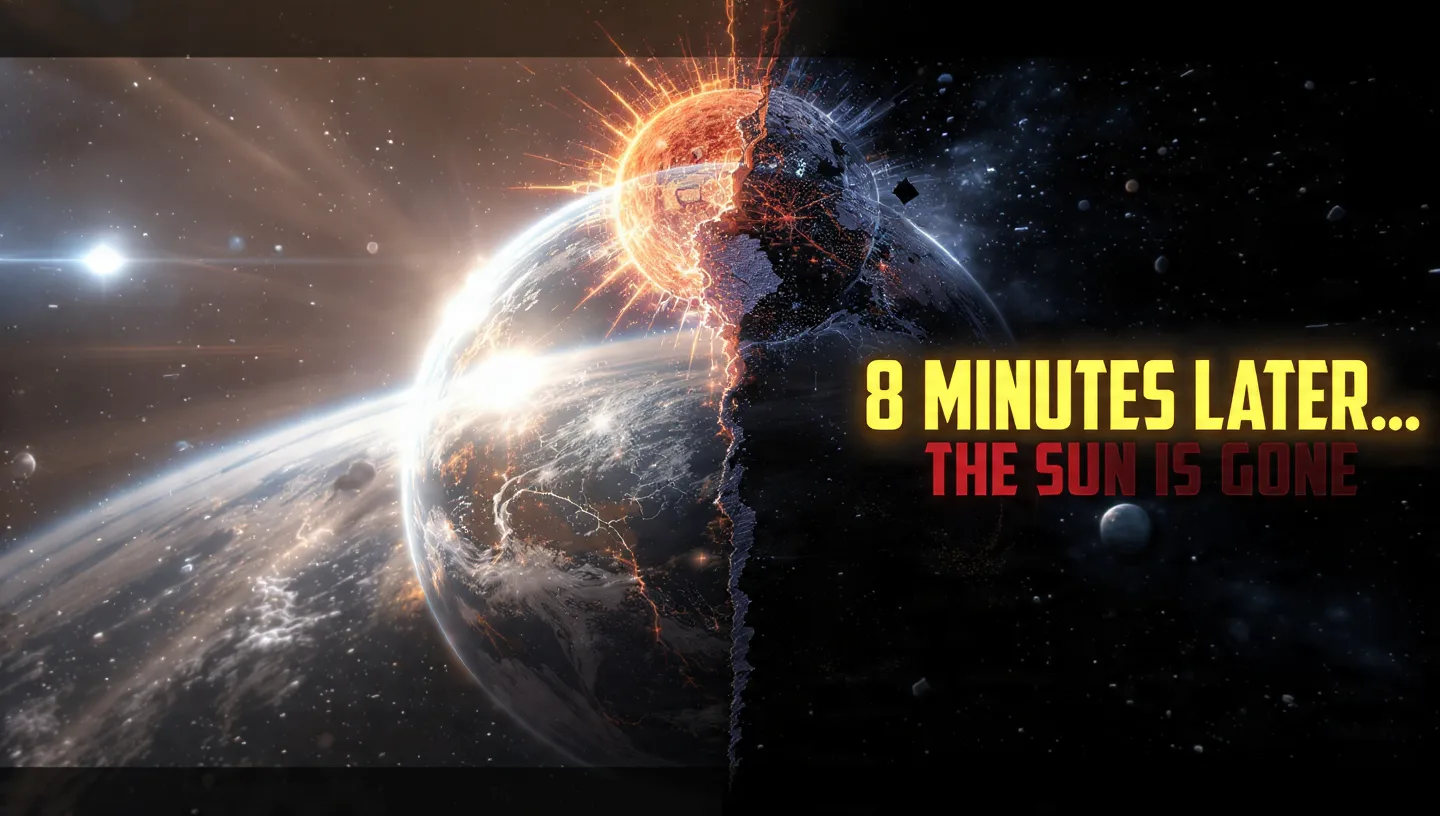
Imagine stepping outside on a sunny afternoon and watching the Sun vanish from the sky. There is no warning, no explosion, and no immediate change in the world around you. For a few minutes, everything appears normal. Then the daylight disappears, temperatures begin to fall, and Earth faces a future unlike anything in human history.
What would happen if the Sun suddenly disappeared? The first change would not be instant freezing. It would be darkness. Over time, the loss of solar energy would disrupt Earth's climate, halt normal photosynthesis, threaten food supplies, and transform the planet's orbit.
There is an important detail behind this thought experiment: sunlight takes about eight minutes and twenty seconds to travel from the Sun to Earth. Changes in the Sun's gravitational influence would also reach us after a similar delay. So, for a little over eight minutes, we would have no way to notice that the Sun had vanished in this hypothetical scenario.
The First Eight Minutes: Why Nothing Seems Different
The Sun is about 150 million kilometres from Earth. Although that distance is enormous, light travels through space at roughly 300,000 kilometres per second. Sunlight reaching us right now left the Sun more than eight minutes ago.
If the Sun somehow vanished instantly, the sunlight already travelling toward Earth would continue arriving. Birds would still see daylight, solar panels would continue receiving light, and the sky would look much as it does now. Nobody would notice an immediate blackout.
Gravity would not change instantaneously either. Under general relativity, changes in the gravitational field propagate at the speed of light. Earth would therefore continue following its familiar orbit until information about the Sun's disappearance reached our planet.
This delay is not a protective force or a special feature of Earth. It is a consequence of the finite speed at which light and gravitational changes travel. After roughly eight minutes and twenty seconds, the last sunlight from the Sun's former position would reach Earth.
Eight Minutes Later: Earth Falls Into Darkness
When the final sunlight arrived, the Sun's visible disk would disappear. Daylight would fade, and the sky would become much darker. Stars that were previously hidden by the bright daytime sky could become visible, depending on atmospheric conditions and local surroundings.
The Moon would also become dark because the light we normally see reflected from its surface comes from the Sun. Artificial lights might remain on in places where electricity was still available, but they would not replace daylight on a planetary scale.
At first, darkness would be the most obvious change. The more serious problem would develop over the hours, days, and longer periods that followed: Earth would no longer receive the steady stream of energy that warms its surface and powers most of its ecosystems.
Would Earth Freeze Immediately?
No. Earth would not turn into a frozen world the instant sunlight disappeared. The land, oceans, and atmosphere contain stored heat, and they would continue releasing and transferring that energy even without incoming sunlight.
Today, Earth absorbs solar energy and releases energy back into space as heat, including infrared radiation. These energy flows help determine the planet's average temperature. If sunlight stopped arriving, Earth would continue radiating heat into space without receiving its usual main energy source.
Temperatures would begin falling, but not at the same rate everywhere. Land generally responds to changes in heating more quickly than the ocean, which can store large amounts of thermal energy. The atmosphere, clouds, winds, and ocean circulation would also affect local conditions.
It is therefore misleading to say that Earth would freeze completely in eight minutes or within a single fixed number of days. The initial blackout would be rapid, but the planet's long-term cooling would be a gradual and complex process.
What Would Happen to Plants, Animals, and Food Chains?
Most of the food chains we depend on begin with organisms that use sunlight. Plants, algae, and many types of microscopic plankton perform photosynthesis, converting light energy into chemical energy that supports growth.
Without sunlight, ordinary photosynthesis would stop. Plants could use some of their stored sugars for a time, but they could not continue producing new sugars through normal photosynthesis. As plant growth failed, the effects would spread through ecosystems.
Herbivores would lose much of their food supply, and predators would face declining prey populations. Aquatic food webs would also be severely disrupted as photosynthetic plankton declined. The speed and scale of these changes would vary between ecosystems.
Humans would face a major food crisis. Agriculture depends on sunlight, and livestock and fisheries are connected to broader food webs. Stored food, greenhouses with artificial lighting, and carefully managed indoor farms could help some communities, but keeping these systems running would require substantial energy and resources.
What Would Happen to Earth's Oceans?
The oceans would gradually lose heat, and sea ice would expand as surface waters cooled. But the ocean would not freeze solid overnight. Water stores considerable thermal energy, and freezing releases latent heat, slowing the process as ice forms.
Deep ocean water could remain liquid beneath growing layers of ice for a long time, depending on local conditions and the evolving temperature of the planet. The timeline would depend on the ocean's heat content, circulation, pressure, and the rate at which heat escaped into space.
Earth's internal heat would continue to flow outward as well. Geothermal energy could help maintain some local environments, including areas around hydrothermal vents, but it would not replace the enormous amount of energy Earth normally receives from the Sun.
The oceans would be changed profoundly, even if some deep water remained liquid. Marine food webs that depend on sunlight-driven plankton would be disrupted, while some communities powered by chemical energy might persist in suitable locations.
Could Humans Survive Without the Sun?
Humanity would face an extraordinary survival challenge, but immediate extinction would not be inevitable. Some people might survive in protected facilities that could provide warmth, water, food, and breathable air while shielding them from the increasingly hostile surface environment.
Nuclear power could generate electricity without direct sunlight. Geothermal energy could provide heat where suitable resources were available. Stored food could support people in the short term, while artificial lighting could make controlled indoor agriculture possible.
However, these options would not be simple solutions for billions of people. Indoor food production needs electricity, water, nutrients, equipment, maintenance, and reliable distribution. Heating and operating shelters would also require functioning infrastructure and supplies.
As temperatures fell and natural ecosystems deteriorated, transport, manufacturing, communications, and food distribution could become harder to maintain. Survival would depend on available resources, energy systems, cooperation, and the ability to keep essential infrastructure operating.
Could Life Survive Without Sunlight?
Surprisingly, not all life depends directly on sunlight. Deep-sea hydrothermal vents and cold seeps support ecosystems in which microbes use chemical energy to produce organic matter. This process is called chemosynthesis.
These communities demonstrate that life can thrive in certain environments where sunlight does not provide the primary energy source. Some underground microorganisms also obtain energy from chemical reactions involving rocks, minerals, and fluids.
If the Sun disappeared, Earth's internal heat and some chemical energy sources would remain. Certain underground or deep-sea environments might therefore continue supporting microbial life, provided they retained liquid water, suitable nutrients, and usable energy.
This does not mean that entire ecosystems would automatically survive unchanged. The loss of sunlight would affect ocean circulation, surface conditions, and the supply of organic material from above. Which communities survived, and for how long, would depend on their local environment.
Would Earth Fly Away From Its Orbit?
Earth orbits the Sun because the Sun's gravity continually changes the direction of our planet's motion. Earth is already moving sideways through space at roughly 107,000 kilometres per hour; its orbit is a curved path rather than a stationary position around the Sun.
If the Sun vanished completely, Earth would not stop moving. Once the change in the Sun's gravitational influence reached us, our planet would continue approximately along the direction it was travelling at that moment, following a path close to a straight line in the absence of other significant forces.
Earth would leave its familiar solar orbit and travel through interstellar space. It would not instantly break apart simply because the Sun was gone. The Moon could remain bound to Earth because Earth's own gravity would still exist.
In that sense, Earth would become a planet without a star to orbit. Its future path through the Milky Way would depend on its existing motion and the gravitational influence of other objects.
Would Earth Eventually Become a Frozen Planet?
Without sunlight, Earth would keep losing energy to space. Over time, the surface would become far colder, ice would spread, and the environment would become increasingly hostile to most familiar forms of life.
If temperatures fell sufficiently, some atmospheric gases could condense or freeze. The atmosphere would change as temperatures and pressures evolved, but the sequence and timing of these changes cannot be described reliably with a single simple countdown.
Earth's interior would not lose all its heat when the Sun disappeared. The planet retains heat from its formation and continues producing internal heat through radioactive decay. That energy escapes gradually and could help keep certain subsurface environments warmer than the surface.
Some isolated places might retain liquid water and support microorganisms for extended periods. But a world with surviving microbial habitats would be very different from today's planet, where sunlight drives the climate and supports most of the food web.
Why the Sun Is Essential for Life on Earth
The Sun does much more than brighten the sky. Solar energy warms Earth's surface and atmosphere, drives evaporation and the water cycle, influences weather, and supports most of the ecosystems on which humans depend.
Everyday things we often take for granted—from crops growing in fields to forests and ocean food webs—depend directly or indirectly on energy from sunlight. Even the energy stored in fossil fuels originally came largely from ancient organisms that captured solar energy.
Other energy sources, including nuclear and geothermal power, could help people operate shelters and produce food in controlled environments. But they would not easily replace the Sun's role in maintaining Earth's natural climate and ecosystems.
Is the Sun Really Going to Disappear?
No known scientific evidence suggests that the Sun will suddenly vanish. It is expected to continue shining for billions of years. Eventually, it will evolve into a red giant as it uses up the hydrogen fuel in its core, a gradual process very different from the sudden disappearance imagined here.
This scenario is a thought experiment, not a prediction. It helps explain how deeply Earth's environment depends on the Sun and how the laws of physics govern light, gravity, heat, and planetary motion.
Final Thoughts: What Would Happen to Earth Without the Sun?
If the Sun disappeared, Earth would not freeze the moment the daylight ended. First, we would experience the roughly eight-minute delay before the last sunlight arrived. Then the planet would begin losing its main external energy source, temperatures would fall, photosynthesis would stop, and food systems would face severe disruption.
Earth would also leave its usual orbit and continue travelling through space. Although some life might persist in protected or chemically powered environments, the ecosystems and climate that support modern life would be transformed.
The Sun can feel like an ordinary part of every day, but it is central to the world we know. Its light powers most of Earth's living systems, warms the planet, and helps make our surface habitable. Imagining a world without it reveals just how much depends on that distant star.
`)}> Copy complete HTML The copy button copies the complete HTML. You can also select and copy from the code below. ```htmlImagine stepping outside on a sunny afternoon and watching the Sun vanish from the sky. There is no warning, no explosion, and no immediate change in the world around you. For a few minutes, everything appears normal. Then the daylight disappears, temperatures begin to fall, and Earth faces a future unlike anything in human history.
What would happen if the Sun suddenly disappeared? The first change would not be instant freezing. It would be darkness. Over time, the loss of solar energy would disrupt Earth's climate, halt normal photosynthesis, threaten food supplies, and transform the planet's orbit.
There is an important detail behind this thought experiment: sunlight takes about eight minutes and twenty seconds to travel from the Sun to Earth. Changes in the Sun's gravitational influence would also reach us after a similar delay. So, for a little over eight minutes, we would have no way to notice that the Sun had vanished in this hypothetical scenario.
The First Eight Minutes: Why Nothing Seems Different
The Sun is about 150 million kilometres from Earth. Although that distance is enormous, light travels through space at roughly 300,000 kilometres per second. Sunlight reaching us right now left the Sun more than eight minutes ago.
If the Sun somehow vanished instantly, the sunlight already travelling toward Earth would continue arriving. Birds would still see daylight, solar panels would continue receiving light, and the sky would look much as it does now. Nobody would notice an immediate blackout.
Gravity would not change instantaneously either. Under general relativity, changes in the gravitational field propagate at the speed of light. Earth would therefore continue following its familiar orbit until information about the Sun's disappearance reached our planet.
This delay is not a protective force or a special feature of Earth. It is a consequence of the finite speed at which light and gravitational changes travel. After roughly eight minutes and twenty seconds, the last sunlight from the Sun's former position would reach Earth.
Eight Minutes Later: Earth Falls Into Darkness
When the final sunlight arrived, the Sun's visible disk would disappear. Daylight would fade, and the sky would become much darker. Stars that were previously hidden by the bright daytime sky could become visible, depending on atmospheric conditions and local surroundings.
The Moon would also become dark because the light we normally see reflected from its surface comes from the Sun. Artificial lights might remain on in places where electricity was still available, but they would not replace daylight on a planetary scale.
At first, darkness would be the most obvious change. The more serious problem would develop over the hours, days, and longer periods that followed: Earth would no longer receive the steady stream of energy that warms its surface and powers most of its ecosystems.
Would Earth Freeze Immediately?
No. Earth would not turn into a frozen world the instant sunlight disappeared. The land, oceans, and atmosphere contain stored heat, and they would continue releasing and transferring that energy even without incoming sunlight.
Today, Earth absorbs solar energy and releases energy back into space as heat, including infrared radiation. These energy flows help determine the planet's average temperature. If sunlight stopped arriving, Earth would continue radiating heat into space without receiving its usual main energy source.
Temperatures would begin falling, but not at the same rate everywhere. Land generally responds to changes in heating more quickly than the ocean, which can store large amounts of thermal energy. The atmosphere, clouds, winds, and ocean circulation would also affect local conditions.
It is therefore misleading to say that Earth would freeze completely in eight minutes or within a single fixed number of days. The initial blackout would be rapid, but the planet's long-term cooling would be a gradual and complex process.
What Would Happen to Plants, Animals, and Food Chains?
Most of the food chains we depend on begin with organisms that use sunlight. Plants, algae, and many types of microscopic plankton perform photosynthesis, converting light energy into chemical energy that supports growth.
Without sunlight, ordinary photosynthesis would stop. Plants could use some of their stored sugars for a time, but they could not continue producing new sugars through normal photosynthesis. As plant growth failed, the effects would spread through ecosystems.
Herbivores would lose much of their food supply, and predators would face declining prey populations. Aquatic food webs would also be severely disrupted as photosynthetic plankton declined. The speed and scale of these changes would vary between ecosystems.
Humans would face a major food crisis. Agriculture depends on sunlight, and livestock and fisheries are connected to broader food webs. Stored food, greenhouses with artificial lighting, and carefully managed indoor farms could help some communities, but keeping these systems running would require substantial energy and resources.
What Would Happen to Earth's Oceans?
The oceans would gradually lose heat, and sea ice would expand as surface waters cooled. But the ocean would not freeze solid overnight. Water stores considerable thermal energy, and freezing releases latent heat, slowing the process as ice forms.
Deep ocean water could remain liquid beneath growing layers of ice for a long time, depending on local conditions and the evolving temperature of the planet. The timeline would depend on the ocean's heat content, circulation, pressure, and the rate at which heat escaped into space.
Earth's internal heat would continue to flow outward as well. Geothermal energy could help maintain some local environments, including areas around hydrothermal vents, but it would not replace the enormous amount of energy Earth normally receives from the Sun.
The oceans would be changed profoundly, even if some deep water remained liquid. Marine food webs that depend on sunlight-driven plankton would be disrupted, while some communities powered by chemical energy might persist in suitable locations.
Could Humans Survive Without the Sun?
Humanity would face an extraordinary survival challenge, but immediate extinction would not be inevitable. Some people might survive in protected facilities that could provide warmth, water, food, and breathable air while shielding them from the increasingly hostile surface environment.
Nuclear power could generate electricity without direct sunlight. Geothermal energy could provide heat where suitable resources were available. Stored food could support people in the short term, while artificial lighting could make controlled indoor agriculture possible.
However, these options would not be simple solutions for billions of people. Indoor food production needs electricity, water, nutrients, equipment, maintenance, and reliable distribution. Heating and operating shelters would also require functioning infrastructure and supplies.
As temperatures fell and natural ecosystems deteriorated, transport, manufacturing, communications, and food distribution could become harder to maintain. Survival would depend on available resources, energy systems, cooperation, and the ability to keep essential infrastructure operating.
Could Life Survive Without Sunlight?
Surprisingly, not all life depends directly on sunlight. Deep-sea hydrothermal vents and cold seeps support ecosystems in which microbes use chemical energy to produce organic matter. This process is called chemosynthesis.
These communities demonstrate that life can thrive in certain environments where sunlight does not provide the primary energy source. Some underground microorganisms also obtain energy from chemical reactions involving rocks, minerals, and fluids.
If the Sun disappeared, Earth's internal heat and some chemical energy sources would remain. Certain underground or deep-sea environments might therefore continue supporting microbial life, provided they retained liquid water, suitable nutrients, and usable energy.
This does not mean that entire ecosystems would automatically survive unchanged. The loss of sunlight would affect ocean circulation, surface conditions, and the supply of organic material from above. Which communities survived, and for how long, would depend on their local environment.
Would Earth Fly Away From Its Orbit?
Earth orbits the Sun because the Sun's gravity continually changes the direction of our planet's motion. Earth is already moving sideways through space at roughly 107,000 kilometres per hour; its orbit is a curved path rather than a stationary position around the Sun.
If the Sun vanished completely, Earth would not stop moving. Once the change in the Sun's gravitational influence reached us, our planet would continue approximately along the direction it was travelling at that moment, following a path close to a straight line in the absence of other significant forces.
Earth would leave its familiar solar orbit and travel through interstellar space. It would not instantly break apart simply because the Sun was gone. The Moon could remain bound to Earth because Earth's own gravity would still exist.
In that sense, Earth would become a planet without a star to orbit. Its future path through the Milky Way would depend on its existing motion and the gravitational influence of other objects.
Would Earth Eventually Become a Frozen Planet?
Without sunlight, Earth would keep losing energy to space. Over time, the surface would become far colder, ice would spread, and the environment would become increasingly hostile to most familiar forms of life.
If temperatures fell sufficiently, some atmospheric gases could condense or freeze. The atmosphere would change as temperatures and pressures evolved, but the sequence and timing of these changes cannot be described reliably with a single simple countdown.
Earth's interior would not lose all its heat when the Sun disappeared. The planet retains heat from its formation and continues producing internal heat through radioactive decay. That energy escapes gradually and could help keep certain subsurface environments warmer than the surface.
Some isolated places might retain liquid water and support microorganisms for extended periods. But a world with surviving microbial habitats would be very different from today's planet, where sunlight drives the climate and supports most of the food web.
Why the Sun Is Essential for Life on Earth
The Sun does much more than brighten the sky. Solar energy warms Earth's surface and atmosphere, drives evaporation and the water cycle, influences weather, and supports most of the ecosystems on which humans depend.
Everyday things we often take for granted—from crops growing in fields to forests and ocean food webs—depend directly or indirectly on energy from sunlight. Even the energy stored in fossil fuels originally came largely from ancient organisms that captured solar energy.
Other energy sources, including nuclear and geothermal power, could help people operate shelters and produce food in controlled environments. But they would not easily replace the Sun's role in maintaining Earth's natural climate and ecosystems.
Is the Sun Really Going to Disappear?
No known scientific evidence suggests that the Sun will suddenly vanish. It is expected to continue shining for billions of years. Eventually, it will evolve into a red giant as it uses up the hydrogen fuel in its core, a gradual process very different from the sudden disappearance imagined here.
This scenario is a thought experiment, not a prediction. It helps explain how deeply Earth's environment depends on the Sun and how the laws of physics govern light, gravity, heat, and planetary motion.
Final Thoughts: What Would Happen to Earth Without the Sun?
If the Sun disappeared, Earth would not freeze the moment the daylight ended. First, we would experience the roughly eight-minute delay before the last sunlight arrived. Then the planet would begin losing its main external energy source, temperatures would fall, photosynthesis would stop, and food systems would face severe disruption.
Earth would also leave its usual orbit and continue travelling through space. Although some life might persist in protected or chemically powered environments, the ecosystems and climate that support modern life would be transformed.
The Sun can feel like an ordinary part of every day, but it is central to the world we know. Its light powers most of Earth's living systems, warms the planet, and helps make our surface habitable. Imagining a world without it reveals just how much depends on that distant star.
Sources & Further Reading
- Climate and Earth’s Energy Budget — NASA Earth Observatory Scientific Paper
- What Is Earth’s Energy Budget? Five Questions with a Guy Who Knows — NASA Scientific Paper (Apr 10, 2017)
- The Life Cycle of a Sun-Like Star (Annotated) — NASA Science Scientific Paper (Aug 28, 2013)
Frequently Asked Questions
UltraFactX Editorial Team
Official editorial and research team at UltraFactX Studio.
Related Discoveries
Explore More from UltraFactX Studio
Dive deeper into the universe, nature, physics, human psychology, and the mysteries of ancient civilization.