
Do Animals Know When Death Is Coming?
Can animals understand when death is near? Explore elephant mourning, dogs, ants, birds, and octopuses through the science of animal behavior.
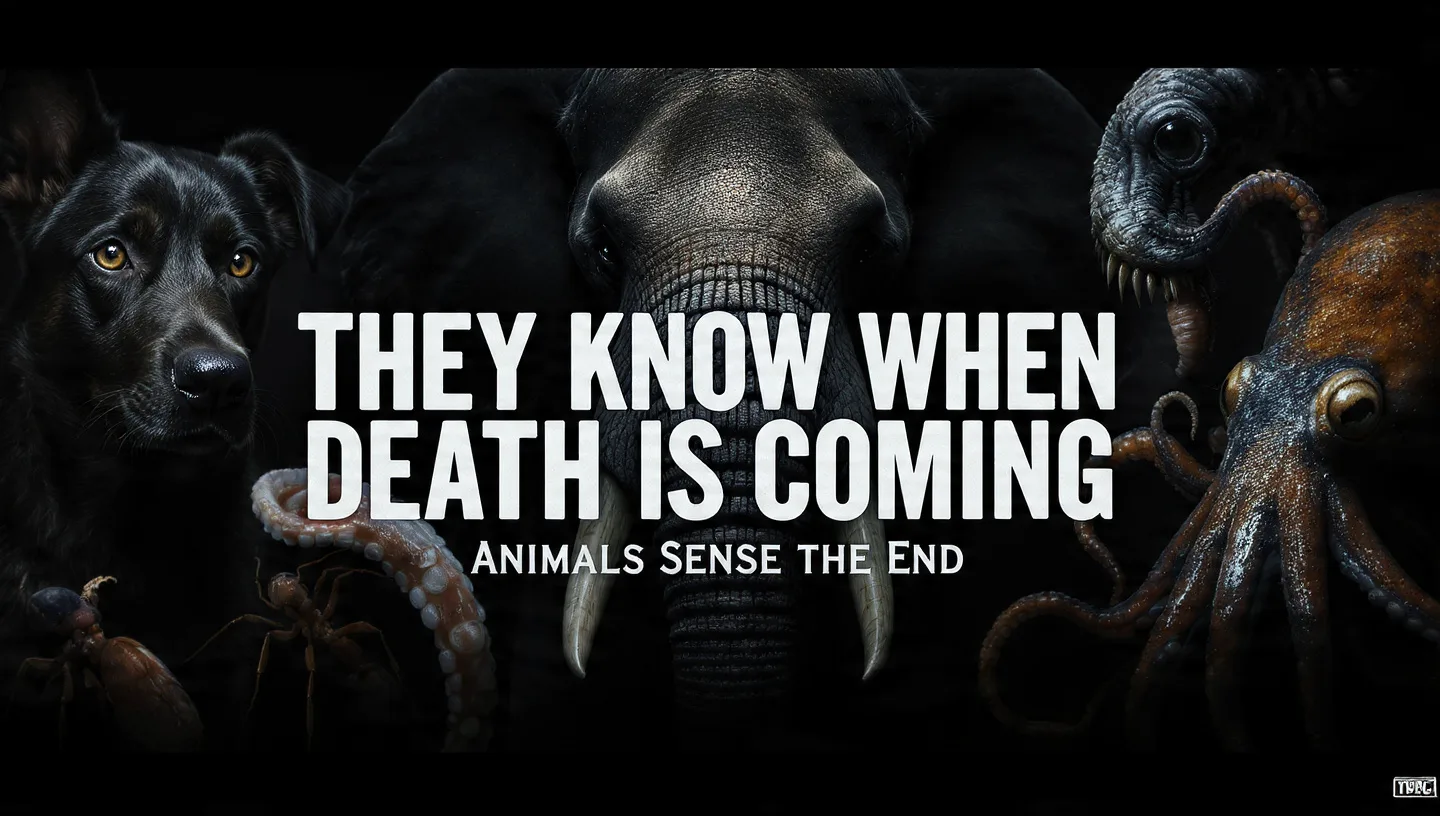
Do Animals Know When Death Is Coming?
Have you ever wondered if animals can sense when death is near?
Animals encounter death as part of life. They may see other animals become sick, injured, weak, or die. Sometimes, their behavior around death can look surprisingly familiar to us.
Elephants may stay near the bodies of dead elephants. Dogs can respond differently to people who are seriously ill. Birds may investigate dead members of their species, while ants remove dead members from their colonies. Some octopus species undergo dramatic biological changes near the end of their lives.
These behaviors are fascinating, but they do not automatically mean that animals can predict death.
Scientists have evidence that many animals can detect and respond to changes associated with illness, injury, death, or danger. What remains much harder to establish is whether an animal understands that death is approaching in the same conscious sense that a human might.
So, what is really happening?
Let's take a closer look.
1. Elephants Seem to Treat Death Differently
Elephants are among the animals that have attracted considerable scientific attention because of their behavior around dead members of their species.
When an elephant dies, other elephants may approach the body. They have been observed touching, smelling, inspecting, and sometimes moving parts of the body. Some elephants have also been observed returning to the remains or bones of other elephants.
What Do Elephants Do Around Dead Elephants?
Researchers have observed elephants showing particular interest in elephant skulls, bones, and other remains. In experiments and field observations, elephants have sometimes spent more time investigating elephant remains than objects from other species.
It is tempting to describe this behavior as mourning or grief.
But scientists need to be careful with those terms.
We cannot ask an elephant what it is feeling. We can observe its behavior and look for patterns that may tell us something about its response to death.
What the evidence does show is that elephants respond to dead members of their species in distinctive ways, and that their behavior around remains can be unusually persistent and investigative.
Can Elephants Know When Another Elephant Is Dying?
This question is much harder to answer.
Elephants have highly developed senses and live in complex social groups. They can detect changes in smell, movement, vocalizations, and behavior. They may therefore recognize when another elephant is injured, distressed, or becoming weak.
That does not mean they can predict the exact moment another elephant will die.
There is currently no strong evidence that elephants possess a special ability to foresee death through a mysterious sixth sense.
What we do know is already remarkable: elephants can detect changes in members of their social group and respond differently when one of their own is seriously injured or dead.
2. Can Dogs Really Sense When Someone Is Dying?
Stories about dogs sensing death are common, particularly accounts of dogs staying close to people who are seriously ill.
Some dogs may behave differently around a sick person, become more attentive, or spend more time nearby.
It can look as though the dog knows that the person is going to die.
There may, however, be a much more natural explanation.
A Dog's Nose Can Notice What We Cannot
Dogs have an extraordinarily sensitive sense of smell. Their noses can detect chemical compounds at concentrations that are far below what humans can normally perceive.
Illness can sometimes produce changes in a person's metabolism and body chemistry. These changes may alter compounds released through breath, sweat, urine, or other bodily fluids.
Research has shown that trained dogs can detect certain diseases and physiological changes, although their ability varies and should not be treated as a general medical diagnostic tool.
So, when a dog behaves differently around a seriously ill person, it does not necessarily mean that the dog can literally “see death.”
It may be responding to changes in smell or other changes in the person's behavior and condition.
Why Do Some Dogs Stay Beside Sick People?
Smell is only one possible explanation.
Dogs are highly social animals that pay attention to human movement, posture, breathing, sounds, routines, and behavior. A dog may notice that something about a person has changed without understanding what that change means in the abstract.
The behavior can therefore be real without requiring a supernatural explanation.
Exactly what an individual dog understands about serious illness or approaching death remains difficult to determine.
3. Birds Can Change Their Behavior Around Death
Birds also respond to dead members of their species.
Crows and other corvids are especially well known for investigating dead birds. Several birds may gather around a dead individual, sometimes repeatedly returning to the location.
To human observers, this can look almost like a funeral.
Why Would a Bird Investigate a Dead Bird?
There are several possible reasons.
A dead bird can be a warning that danger is nearby.
There could be a predator in the area. The bird may have encountered a territorial threat, poison, or another environmental hazard.
For an intelligent bird, investigating the area may therefore provide useful information about potential danger.
Research on American crows has found that exposure to dead crows can produce defensive responses and influence how they behave around locations associated with danger.
What looks like a funeral may therefore involve an important form of threat assessment and learning.
There May Not Be One Simple Explanation
This does not prove that birds have no emotional response to death.
It simply means that we should be careful when translating animal behavior into human emotional language.
An animal can respond strongly to the death of another animal without necessarily thinking about mortality in the same abstract way that humans do.
4. Ants Have Their Own Way of Dealing With Death
Ants provide one of the clearest examples of how an animal society responds to dead members.
Ant colonies are highly organized. Ants communicate using chemical signals that help them find food, defend the colony, coordinate work, and respond to threats.
They also use chemical information when dealing with dead ants.
How Do Ants Recognize a Dead Ant?
After an ant dies, chemical changes occur on its body.
Research has shown that compounds associated with death can trigger worker ants to remove the body from the nest. One chemical historically associated with this process is oleic acid, although the chemical signals involved can be more complex than a single compound.
This behavior is known as necrophoresis.
Worker ants carry dead ants away from the colony, helping reduce the potential spread of pathogens and keeping the nest cleaner.
It is an effective biological system that protects the colony without requiring the ants to understand death in a human-like way.
Do Ants Understand That They Are Dying?
There is no good evidence that ants understand their own mortality in the way humans do.
Their responses to dead or dying colony members appear to depend heavily on chemical signals and evolved behavioral mechanisms.
The interesting part is that the colony does not need a human-like concept of death to respond effectively. Natural selection can produce remarkably sophisticated systems through relatively simple biological signals.
5. Octopuses Change Near the End of Their Lives
Octopuses are already unusual animals. They can solve problems, manipulate objects, learn from experience, and display complex behaviors.
Some species also have an unusual life cycle in which reproduction is closely followed by major physiological changes and death.
Why Do Octopuses Stop Eating?
In many octopus species, females lay eggs and remain with them while they develop. During this period, they may stop eating and devote much of their energy to protecting and caring for the eggs.
As the reproductive period continues, dramatic changes take place in the animal's physiology and behavior.
In many species, the female eventually dies around the time the eggs hatch.
Scientists have linked this process to changes involving the optic glands and hormonal pathways that regulate the animal's behavior and metabolism after reproduction.
The octopus is therefore not necessarily making a conscious decision to die.
Its body is undergoing a biological process strongly connected to reproduction.
A Life Cycle With a Natural Ending
This type of reproductive strategy is called semelparity. It refers to animals that reproduce once and then die.
For some octopuses, reproduction and the end of life are therefore closely connected.
From the outside, this can look almost intentional. But biology does not require an animal to consciously plan the end of its life for such a life cycle to evolve.
Evolution can produce complex reproductive strategies through natural selection without requiring conscious foresight.
6. So, Can Animals Actually Sense Death?
This is where we need to separate what science has found from the more dramatic stories we often hear.
There is no general scientific evidence that animals possess a supernatural ability to predict death.
But many animals can detect changes that humans may not easily notice.
- Changes in body odor
- Changes in movement and posture
- Changes in breathing or vocalizations
- Changes in body chemistry
- Changes in behavior
- Signs of illness, injury, or weakness
- Changes in the surrounding environment
- Chemical signals associated with dead organisms
When an animal combines information from several senses, it may notice that something is wrong long before a human observer does.
That can make it appear as though the animal somehow knows what is going to happen.
But the explanation may be much more natural.
The animal may simply be detecting information that humans cannot easily perceive.
7. Maybe Animals Don't “Know” Death — They Notice Change
There is one idea that connects many of these examples.
Animals are exceptionally good at detecting changes in their surroundings.
A dog can detect odors that humans cannot.
An elephant can notice changes in another elephant's condition and behavior.
A crow can respond to a dead crow and learn that a particular location may be dangerous.
An ant can respond to chemical changes associated with a dead member of its colony.
An octopus can undergo major biological changes as its reproductive cycle reaches its end.
None of these examples requires a mysterious sixth sense.
And that does not make them any less fascinating.
In fact, it highlights how differently other animals can experience and interpret the world around them.
Do Animals Understand Death?
This may be the most difficult question of all.
Some animals clearly respond to dead members of their species. Some investigate bodies or bones. Others change their behavior after losing another animal.
But observing a behavior is not the same as knowing exactly what an animal understands or feels.
Scientists can study behavior, hormones, brain activity, communication, and other physical changes. What is much harder to measure is an animal's private subjective experience.
Does an elephant understand that another elephant will never return? Does a crow understand why another crow died? Does a dog understand that a seriously ill person may be approaching the end of life?
We do not have simple answers to these questions.
That is why scientists need to be careful with words such as “grief,” “mourning,” or “awareness.” These terms can be useful when describing observed behavior, but they do not automatically prove that an animal experiences death in exactly the same way a human does.
The Strange Truth About Death in Nature
Maybe the most interesting part is not whether animals have a secret ability to predict death.
They may not need one.
Animals have incredibly sensitive ways of gathering information about their surroundings.
They can smell things we cannot smell. They can hear and detect signals that may be difficult for us to perceive. They can notice subtle changes in movement and behavior, and some species respond to chemical signals that humans cannot detect directly.
Because of these abilities, an animal can sometimes appear to know something before we do.
It may not understand death in the same philosophical way humans do. Instead, it may simply be responding to many small changes happening around it.
And that is fascinating in its own way.
Final Thoughts
Animals may not have a mysterious power to see the future, but many can notice parts of the present that humans often miss.
Elephants investigate the bodies and bones of their dead.
Dogs can detect subtle changes in smell and behavior and may respond differently when a person is seriously ill.
Birds can react to dead members of their species and may learn from possible dangers.
Ants use chemical signals to remove dead members from their colonies.
And some octopuses undergo remarkable biological changes as their reproductive cycle comes to an end.
None of these examples gives us a simple answer to whether animals actually “know” when death is coming.
But perhaps that is what makes the subject so interesting.
The natural world contains an enormous amount of information that human senses cannot detect directly.
So, the next time an animal behaves strangely, there may be a reason behind it — something it can smell, hear, feel, or otherwise detect that we simply cannot.
Maybe the real mystery isn't whether animals can predict death.
Maybe the real mystery is how much of the world animals can perceive that we never notice.
If you enjoy strange animal behavior, unusual natural phenomena, and science that makes us look at the world differently, explore more from UltraFactX Studio.
Sources & Further Reading
- African elephants show high levels of interest in the skulls and ivory of their own species — Karen McComb, Lucy Baker, Cynthia Moss Scientific Paper (Jan 1, 2006) DOI: 10.1098/rsbl.2005.0400
- Wild American crows gather around their dead to learn about danger — Kaeli N. Swift, John M. Marzluff Scientific Paper (Jan 1, 2015) DOI: 10.1016/j.anbehav.2015.08.021
- Canine olfactory detection and its relevance to medical detection — BMC Veterinary Research Scientific Paper (Oct 1, 2021) DOI: 34412582
- Multiple optic gland signaling pathways implicated in octopus maternal behaviors and death — Wang & Ragsdale Research Institution (Nov 1, 2018) DOI: 10.1242/jeb.185751
Frequently Asked Questions
UltraFactX Editorial Team
Official editorial and research team at UltraFactX Studio.
Related Discoveries
Explore More from UltraFactX Studio
Dive deeper into the universe, nature, physics, human psychology, and the mysteries of ancient civilization.