
These Places on Earth Are Closed to Humans — Here’s Why
There are places on Earth humans cannot freely enter. Discover why Chernobyl, Snake Island, Area 51, North Sentinel Island and more remain restricted.
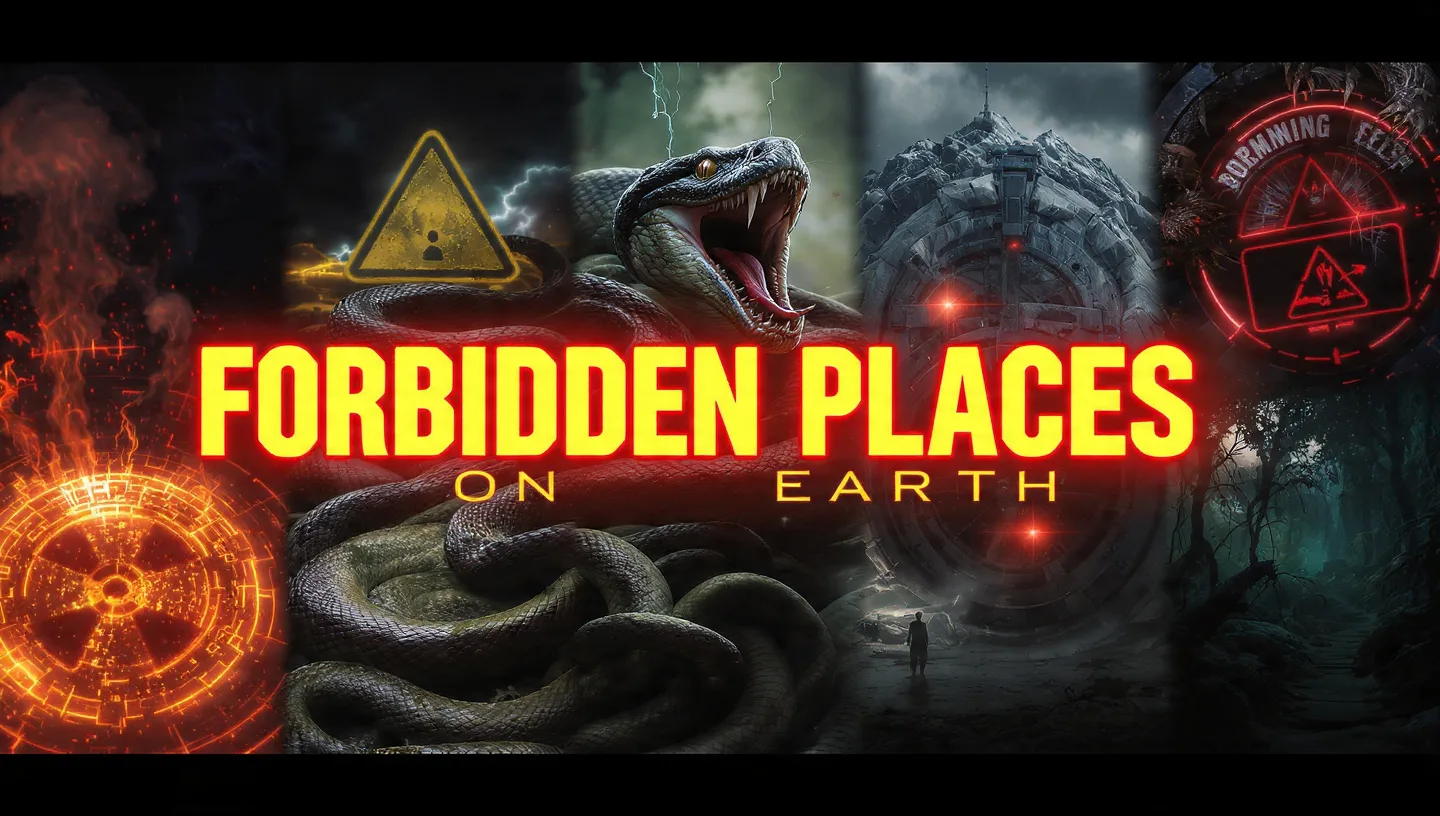
We often think we know our planet pretty well. Satellites can photograph remote places from space, maps cover almost every part of the world, and modern technology lets us explore places that were once completely out of reach.
But Earth still has places where you cannot simply walk in.
Some are restricted because they are dangerous. Others are protected because of rare wildlife, fragile ecosystems, national security, or the people who live there. Some contain materials that require extraordinary levels of safety and security.
What makes these places interesting is that they are not just stories from the past. Many remain active, protected, or restricted today.
1. Chernobyl's Reactor 4 — A Site That Still Requires Protection
When people hear the word Chernobyl, they often picture an abandoned city surrounded by vegetation and empty buildings. But one of the most important restricted areas is the destroyed Reactor 4 at the Chornobyl Nuclear Power Plant.
The reactor was destroyed during the 1986 nuclear accident, leaving the damaged reactor unit and radioactive material inside a structure known as the Shelter. A much larger protective structure, the New Safe Confinement, was later built over it to help contain radioactive material and support long-term work at the site.
The site still requires continuous monitoring and specialized nuclear-safety work. And the story is not entirely frozen in 1986. On February 14, 2025, a drone struck the New Safe Confinement, causing a fire and significant damage to parts of the structure. The International Atomic Energy Agency reported that radiation levels remained normal after the incident, but later assessments found that the confinement function of the structure had been compromised.
That makes Chernobyl very different from an ordinary abandoned site. The damaged reactor remains an active nuclear-safety concern, and access requires specialized procedures and authorization.
2. Snake Island, Brazil — A Protected Home of a Rare Snake
Just off the coast of São Paulo, Brazil, lies Ilha da Queimada Grande, better known around the world as Snake Island.
The island is the natural home of the golden lancehead, Bothrops insularis, a venomous pitviper found nowhere else in the wild. The species is critically endangered, and the island itself is a legally protected conservation area.
Ordinary visitors cannot simply land on the island. Access is restricted, with visits associated with authorized scientific research and environmental management rather than normal tourism.
The reason is more complicated than the popular image of an island filled with dangerous snakes. The restrictions also help protect a very small and vulnerable ecosystem. Researchers have documented concerns including habitat disturbance, illegal collection, and the species' extremely limited geographic range.
So Snake Island is not simply a place humans are told to avoid because of venomous animals. It is also a conservation site protecting a species that exists naturally in only one small location.
3. Svalbard Global Seed Vault — A Backup Plan for Our Food
Imagine a vault built inside a mountain, filled with seeds from crops grown around the world.
That is essentially what the Svalbard Global Seed Vault is.
Located on the Norwegian archipelago of Svalbard, the vault stores backup copies of seeds held in gene banks around the world. Its purpose is to safeguard crop diversity so that important plant varieties are not permanently lost.
Why does that matter?
Wars, natural disasters, disease, climate-related problems, and other major events can threaten agricultural systems. If crop varieties disappear from other collections, preserved seeds can potentially help restore them in the future.
The vault is built deep inside a mountain on the island of Spitsbergen. It uses the naturally cold Arctic environment together with artificial cooling to maintain suitable storage conditions. In June 2026, the facility reported that its collection had surpassed 1.4 million seed samples.
Unlike Chernobyl or Snake Island, the main reason for restricted access here is not an immediate danger to visitors. The vault is a carefully controlled facility designed to protect an irreplaceable backup of agricultural biodiversity.
4. Area 51 — The Real Story Behind the Mystery
Few places have attracted as much curiosity as Area 51.
Located at Groom Lake in the Nevada desert, the highly restricted site became closely associated with secret military aviation programs during the Cold War.
The CIA has confirmed that Groom Lake was used as a secret testing site for the U-2 reconnaissance aircraft and the A-12 OXCART program. The isolated location helped engineers and pilots test aircraft away from public view.
Its secrecy helped fuel decades of UFO stories and alien theories. But the documented history is already fascinating without them.
The U-2 was designed for high-altitude reconnaissance, while the A-12 was developed as an extremely fast, high-flying reconnaissance aircraft. Both programs involved technologies that the U.S. government wanted to keep secret during the Cold War.
So while popular culture continues to associate Area 51 with extraterrestrials, the documented reason for its secrecy is much more down to Earth: classified military research, aircraft testing, and national security.
5. North Sentinel Island — A Place Best Left Alone
In India's Andaman and Nicobar Islands lies North Sentinel Island, home to the Sentinelese, an Indigenous community that has remained largely isolated from the outside world.
The Indian government has declared the entire island and surrounding coastal waters a protected tribal reserve. Entry by outsiders is prohibited.
But unlike Area 51, the restriction is not about keeping a secret military project hidden.
It is about protecting the Sentinelese and respecting their decision to remain isolated.
Contact with outsiders could expose the community to infectious diseases to which they may have little or no immunity. Unwanted contact could also disrupt their society and way of life.
The Indian government has therefore described its approach as “eyes-on and hands-off”: authorities monitor the area from a distance while avoiding direct contact. Surveillance and patrols are used to discourage unauthorized approaches.
North Sentinel Island is a useful reminder that not every inaccessible place needs to be opened simply because modern technology makes it possible to reach it.
6. High-Security Laboratories Holding Smallpox Virus
Not every restricted place looks mysterious from the outside. Some are simply high-security laboratories.
Among the most sensitive biological materials still held under international controls is live variola virus, the virus that causes smallpox.
The World Health Organization states that remaining live variola virus stocks are held in two authorized repositories: one at the U.S. Centers for Disease Control and Prevention in Atlanta and another at the State Research Centre of Virology and Biotechnology in Russia.
These materials are not available for ordinary access. The repositories are subject to strict biosafety and biosecurity requirements, and the World Health Organization conducts periodic inspections of the facilities.
Smallpox was declared eradicated in 1980 after a worldwide vaccination campaign. The continued existence of live variola virus stocks has remained the subject of international debate, particularly over whether they should be destroyed or retained for carefully controlled research.
Here, the locked doors are not about creating a mystery. They are about reducing the risks associated with one of the world's most dangerous known viruses.
Why Are These Places Restricted?
At first glance, these locations do not seem to have much in common.
One contains the remains of a nuclear disaster. Another protects a rare snake. One stores seeds, another is associated with classified military technology, and another protects an isolated Indigenous community.
Yet they share an important principle: unrestricted access could create serious risks.
- Chernobyl requires strict nuclear safety, monitoring, and controlled access.
- Snake Island protects a rare species and a highly restricted ecosystem.
- Svalbard Global Seed Vault protects a backup collection of global crop diversity.
- Area 51 has historically been used for classified military aircraft development and testing.
- North Sentinel Island is protected to respect and safeguard an isolated Indigenous community.
- Smallpox repositories require exceptional biological safety and security.
Earth Still Has Boundaries
Technology has made our planet feel smaller than ever.
We can photograph remote islands from space, send robots into places humans cannot safely reach, and communicate with someone on the other side of the world almost instantly.
But being able to see a place does not mean we are allowed to enter it.
Some boundaries exist because something inside needs protection. Sometimes it is an ecosystem. Sometimes it is a community. Sometimes it is dangerous technology, radioactive material, or biological research.
And perhaps that is what makes these places so fascinating.
Not every locked door hides a secret. Sometimes it exists because opening it could cause damage that cannot easily be undone.
Even in an age of satellites, artificial intelligence, and global travel, Earth still has places where the most responsible thing humans can do is stay outside.
Explore more fascinating science, nature, history, and unexplained stories with UltraFactX Studio.
Sources & Further Reading
- Chornobyl Nuclear Power Plant — New Safe Confinement Damage and Nuclear Safety — International Atomic Energy Agency (IAEA) Government Agency
- Svalbard Global Seed Vault — Svalbard Global Seed Vault / Norwegian Ministry of Agriculture and Food Reputable Reference
- Ask Molly: What really went on at Area 51? — Central Intelligence Agency (CIA) Government Agency
- Research Using Live Variola Virus — World Health Organization (WHO) Government Agency
Frequently Asked Questions
UltraFactX Editorial Team
Official editorial and research team at UltraFactX Studio.
Related Discoveries

Explore More from UltraFactX Studio
Dive deeper into the universe, nature, physics, human psychology, and the mysteries of ancient civilization.